012026UPCOMING / NOVEMBER 2026
Euclid Data Release 1 (DR1): Double-source-plane lens candidates
Euclid Collaboration: Tian Li et al. · In preparation
Scheduled for release in November 2026
UPCOMING
A forthcoming Euclid DR1 study presenting double-source-plane lens candidates selected through machine-learning searches and visual inspection, followed by lens modelling to test the multiple-source-plane interpretation.
022026JWST / LENSED QUASAR
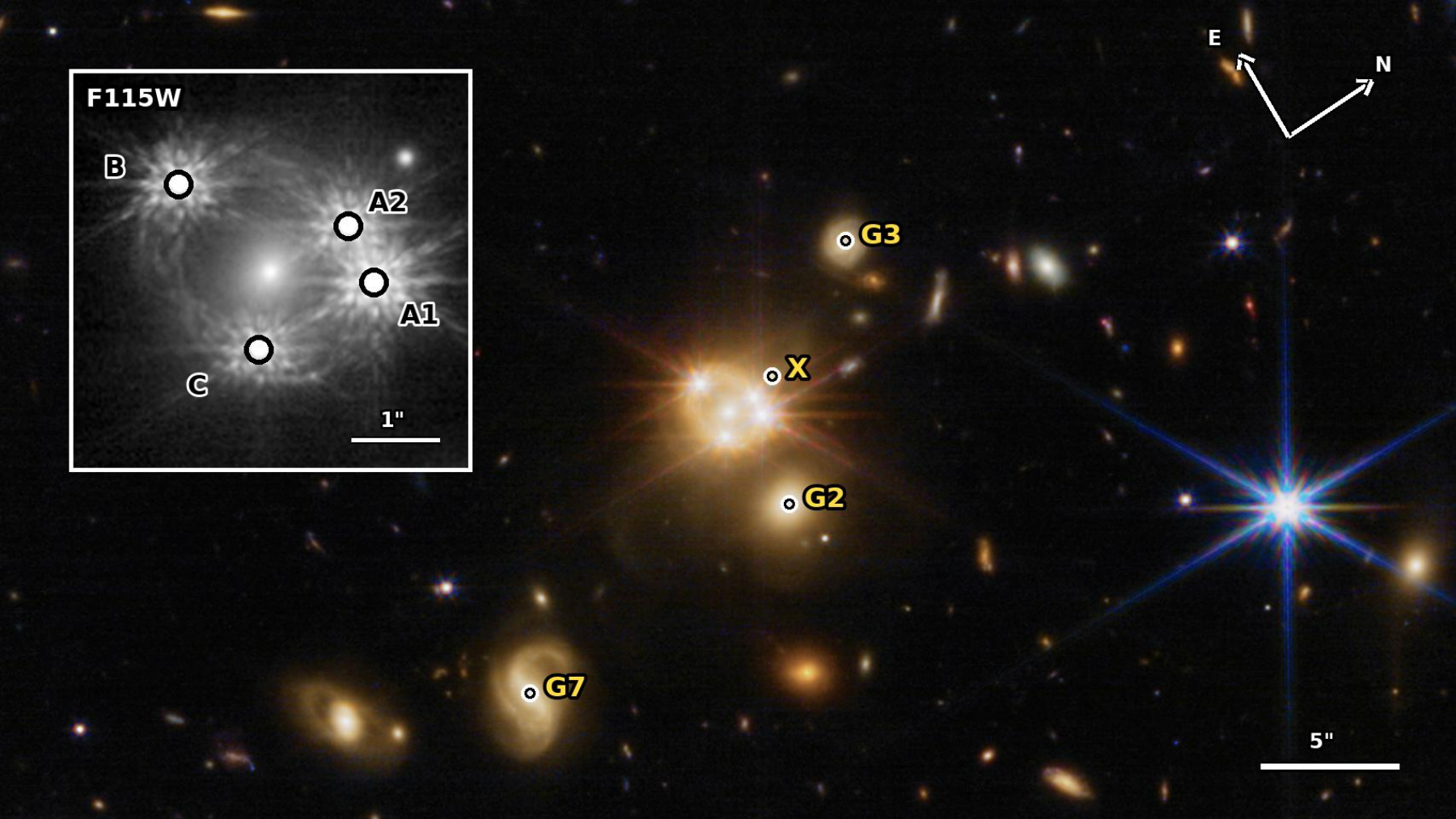
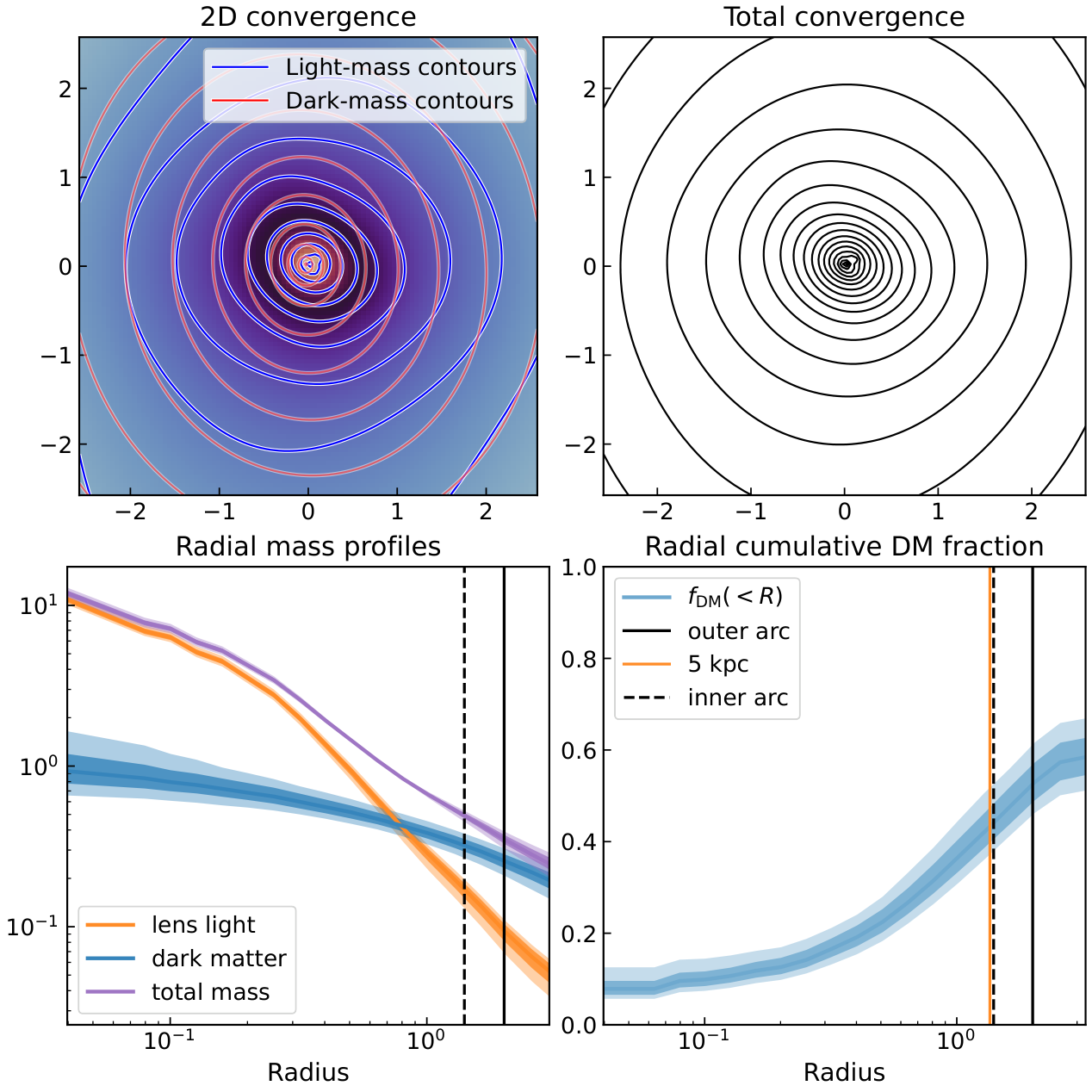
Disentangling the dark and stellar mass through precise lens modelling of the JWST observation of lensed quasar WFI2033–4723
Tian Li, Thomas E. Collett, Coleman M. Krawczyk, Wolfgang J. R. Enzi, Aymeric Galan
View on arXiv ↗
ABSTRACT
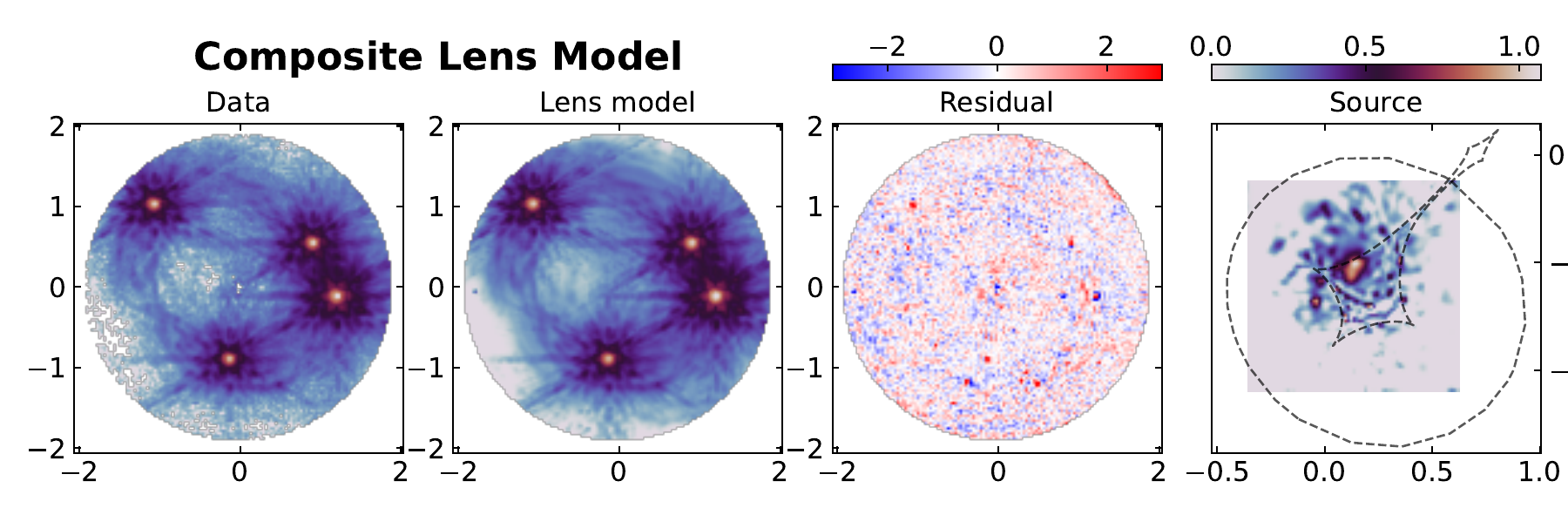
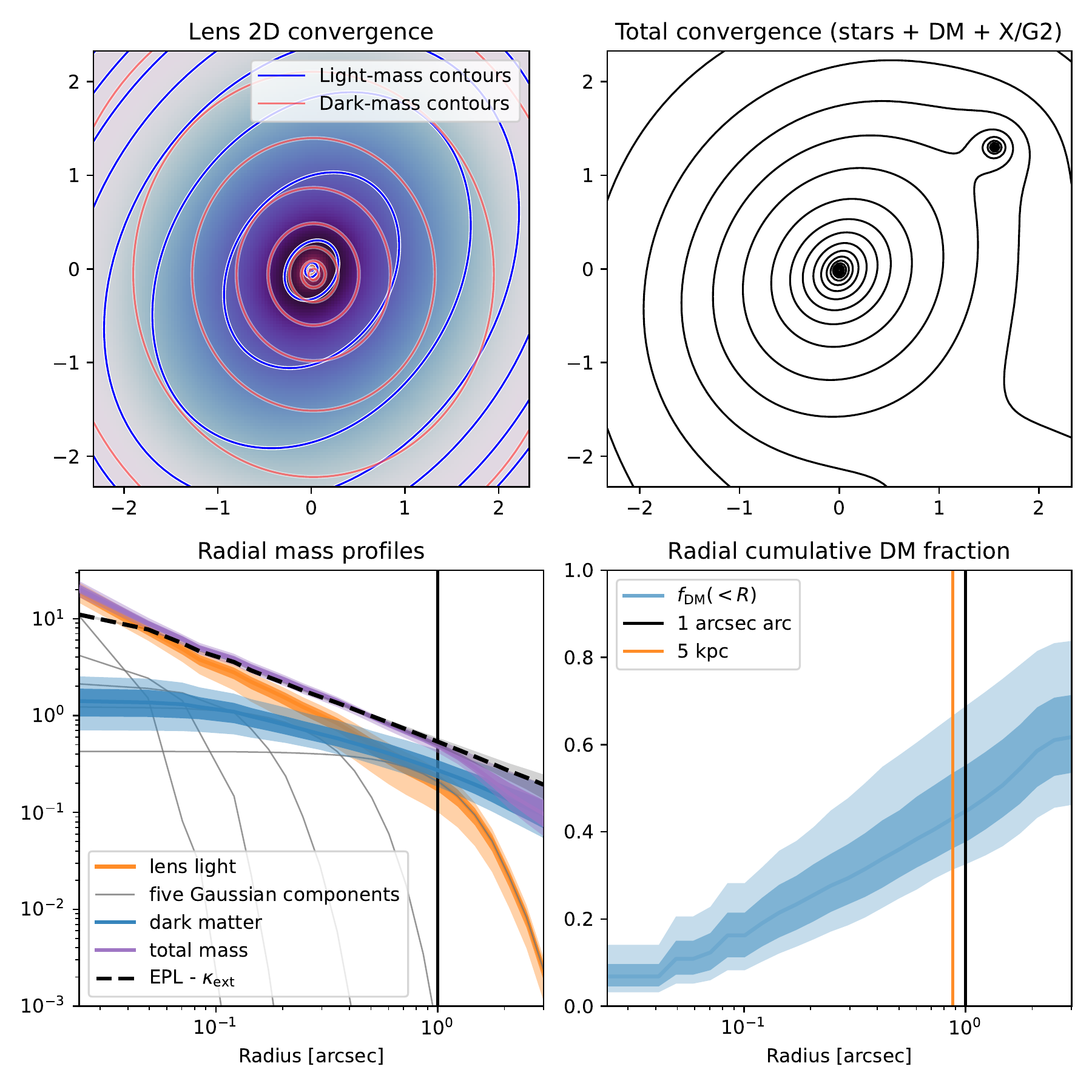
We use high-resolution JWST/NIRCam imaging and measured time delays to model the quadruply imaged quasar WFI2033–4723. After establishing an elliptical power-law baseline whose Fermat-potential differences agree with earlier HST and JWST analyses, we replace the total mass profile with a physical decomposition: a multi-Gaussian stellar component with a free radial mass-to-light gradient and a generalized NFW dark-matter halo.
The time delays, combined with either Planck+DESI or Pantheon+SH0ES cosmological information, limit the mass-sheet freedom and make the stellar–dark-matter separation possible. Both cases place the stellar normalization between Chabrier and Salpeter expectations and prefer a mildly steep inner halo, γin ≃ 1.3, while the main astrophysical conclusions remain insensitive to the cosmological prior. Reversing the analysis does not yield a robust standalone H0 constraint because H0 remains strongly degenerate with the halo scale radius.
032026DOUBLE-SOURCE-PLANE LENS
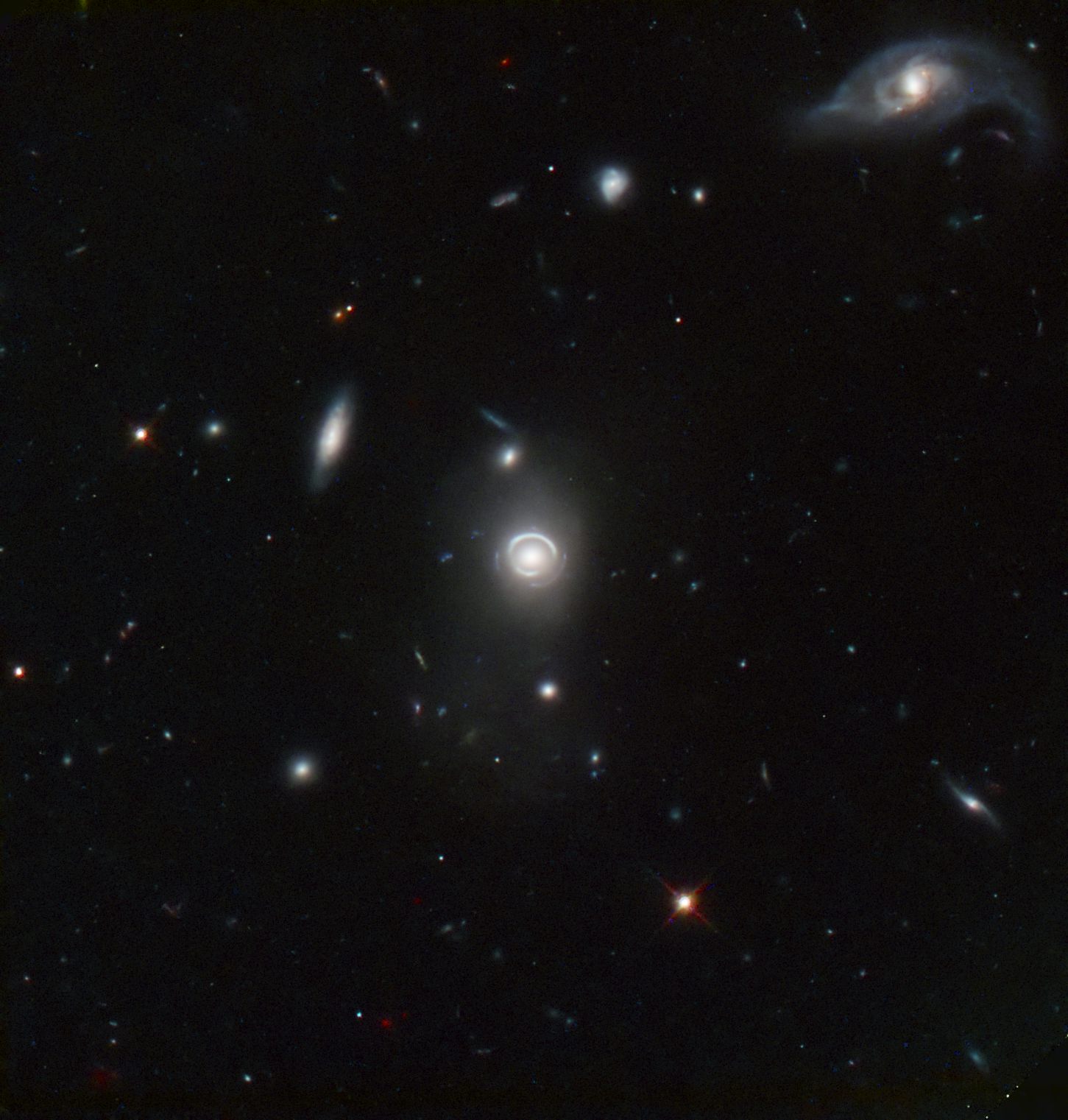
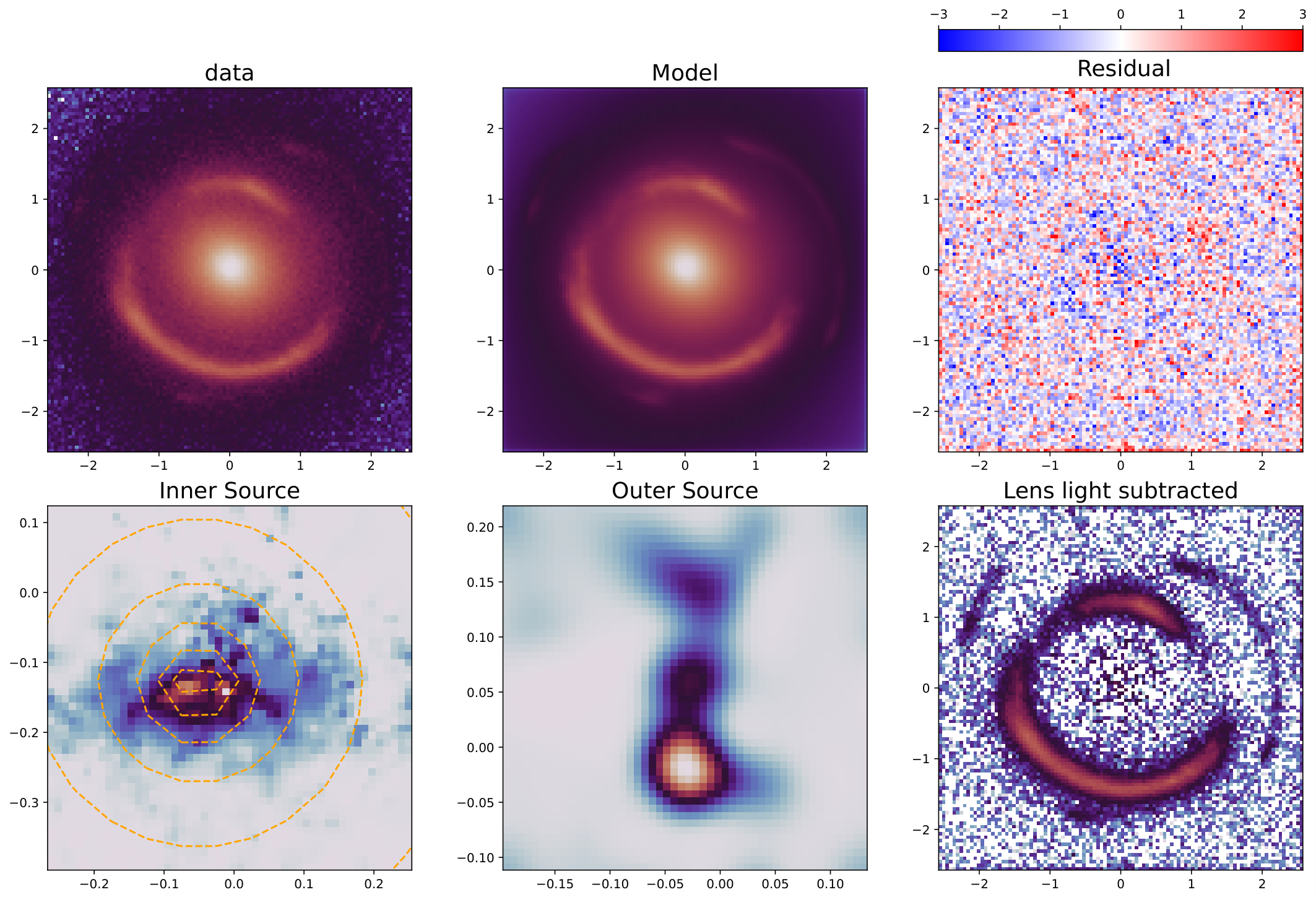
A Salpeter IMF and an NFW halo: disentangling the dark and stellar mass of an elliptical galaxy through precise lens modelling of a double-source-plane system
Tian Li, Thomas E. Collett, Coleman M. Krawczyk, Giovanni Granata, Wolfgang J. R. Enzi, Daniel J. Ballard, et al. · MNRAS 548, stag683
View paper ↗
ABSTRACT
We use the double-source-plane lens J0946+1006 to separate stellar and dark matter components with a flexible two-component mass model. The stellar light is described with a multi-Gaussian expansion, a free global mass-to-light ratio, and an allowed radial mass-to-light gradient, while the halo is modelled as an elliptical generalized NFW profile. The extra leverage from the double-source-plane geometry helps suppress the mass-sheet transformation and tighten constraints on the radial mass profile.
Even with this freedom, the preferred solution remains close to the canonical picture of a massive elliptical galaxy: an almost constant stellar mass-to-light ratio with Salpeter-like IMF normalization and a halo consistent with NFW. The inferred parameters are M★ = 4.4+0.25−0.39 × 10¹¹ M⊙, γinhalo = 1.04+0.10−0.14, and M200halo = 1.11+0.37−0.32 × 10¹³ M⊙, suggesting a practical template for future Euclid double-source-plane lens analyses.
042025EUCLID Q1 / DISCOVERY ENGINE D
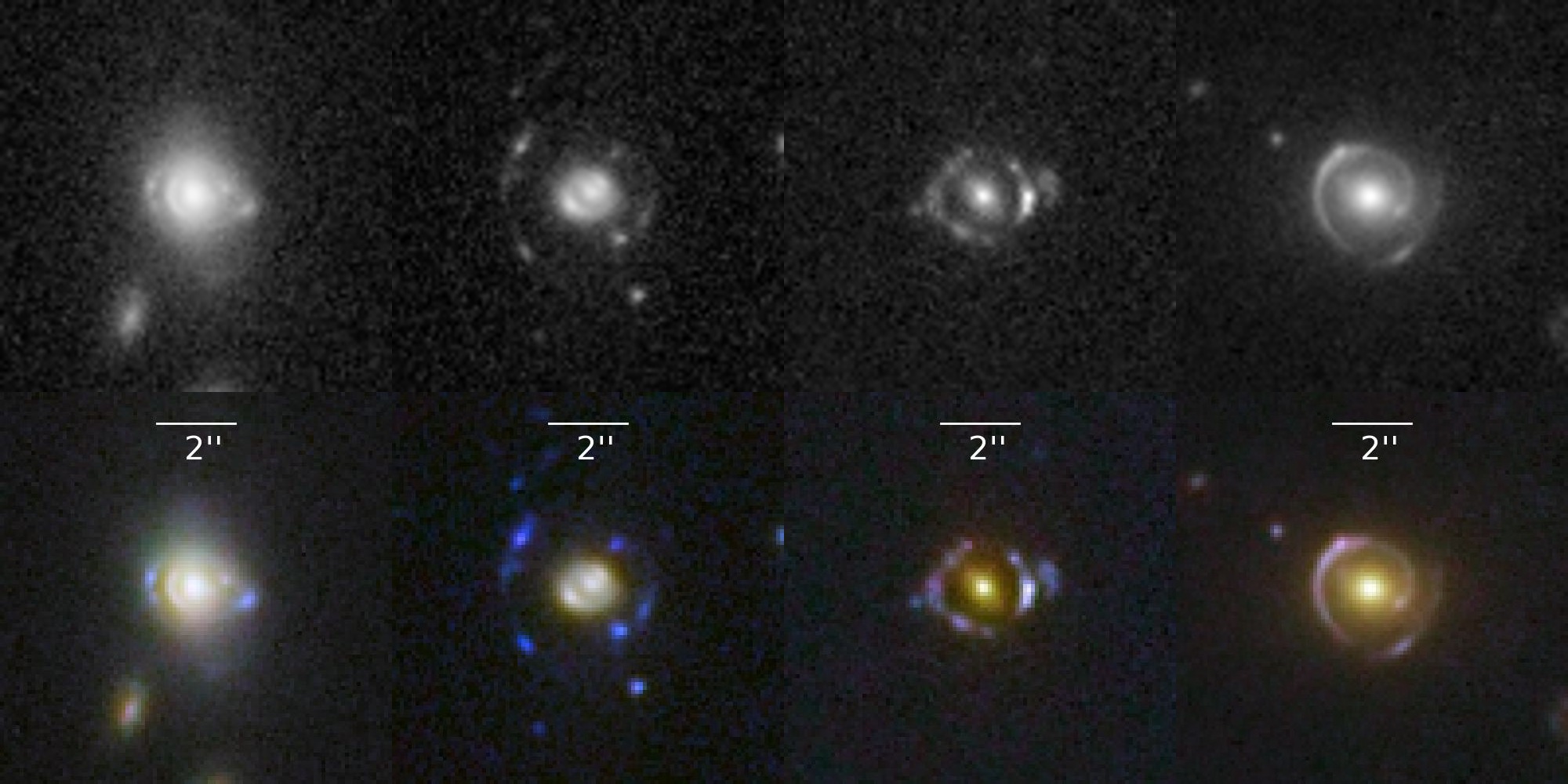
Euclid Quick Data Release (Q1). The Strong Lensing Discovery Engine D — Double-source-plane lens candidates
T. Li, T. E. Collett, M. Walmsley, N. E. P. Lines, K. Rojas, J. W. Nightingale, et al.
View on arXiv ↗
ABSTRACT
Galaxy-scale double-source-plane lenses are rare but especially valuable because the ratio of their Einstein radii depends on the cosmological scaling factor β, while the systems also probe lens density profiles and dark-matter substructure. In Euclid Q1, four new double-source-plane lens candidates were identified through a combination of machine-learning lens finders and subsequent visual inspection by citizens and experts.
Using the widely used LensPop forecast model, the paper predicts roughly 1700 double-source-plane lenses over the full Euclid survey, corresponding to about 6 ± 3 systems in the 63 deg² Q1 area, consistent with the current detections. Initial lens models and β estimates are presented for each candidate, demonstrating Euclid's ability to build statistically useful samples of these rare systems.
052025TIME-DELAY COSMOGRAPHY
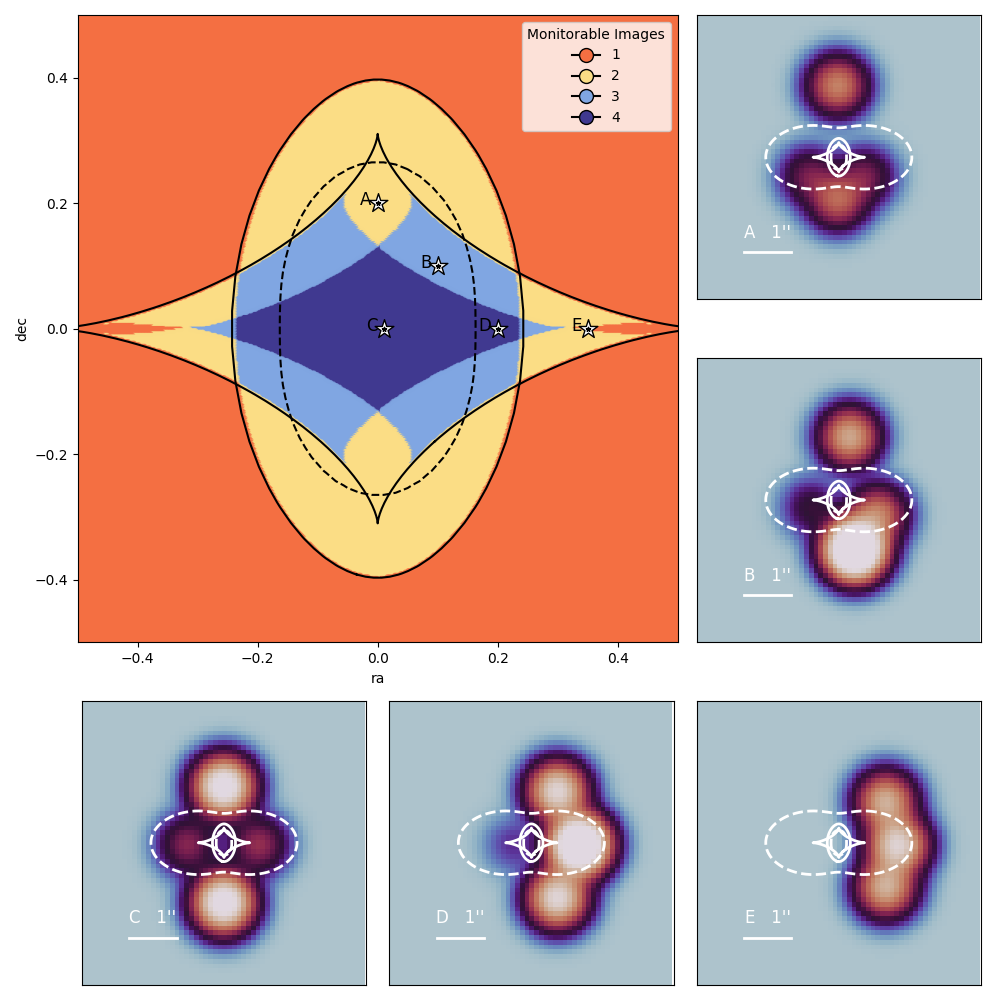
Correcting for selection biases in the determination of the Hubble constant from time-delay cosmography
Tian Li, Thomas E. Collett, Philip J. Marshall, Sydney Erickson, Wolfgang Enzi, Lindsay Oldham, et al. · MNRAS 538, 2375–2391
View paper ↗
ABSTRACT
Time-delay cosmography measures H0 from the delays between multiple images of lensed quasars, but the dominant systematic comes from the mass-sheet transform, which leaves lensing observables unchanged while shifting the inferred Hubble constant. This work tests whether galaxy-galaxy lenses and galaxy-quasar lenses really share the same density-profile family by modelling the parent deflector population with separate stellar and dark-matter components and by explicitly modelling the selection functions for both lens samples.
A power-law profile plus an internal mass sheet remains a good approximation near the Einstein radius, but galaxy-galaxy lenses are found to prefer systematically larger mass-sheet contributions than galaxy-quasar lenses. Propagating that difference through the TDCOSMO framework lowers the inferred Hubble constant by a further ≃3%, yielding H0 = 66 ± 4 (stat) ± 1 (model sys) ± 2 (measurement sys) km s−1 Mpc−1 for the combined TDCOSMO plus SLACS data set.
062024POPULATION COSMOLOGY
Cosmology from large populations of galaxy–galaxy strong gravitational lenses
Tian Li, Thomas E. Collett, Coleman M. Krawczyk, Wolfgang Enzi · MNRAS 527, 5311–5323
View paper ↗
ABSTRACT
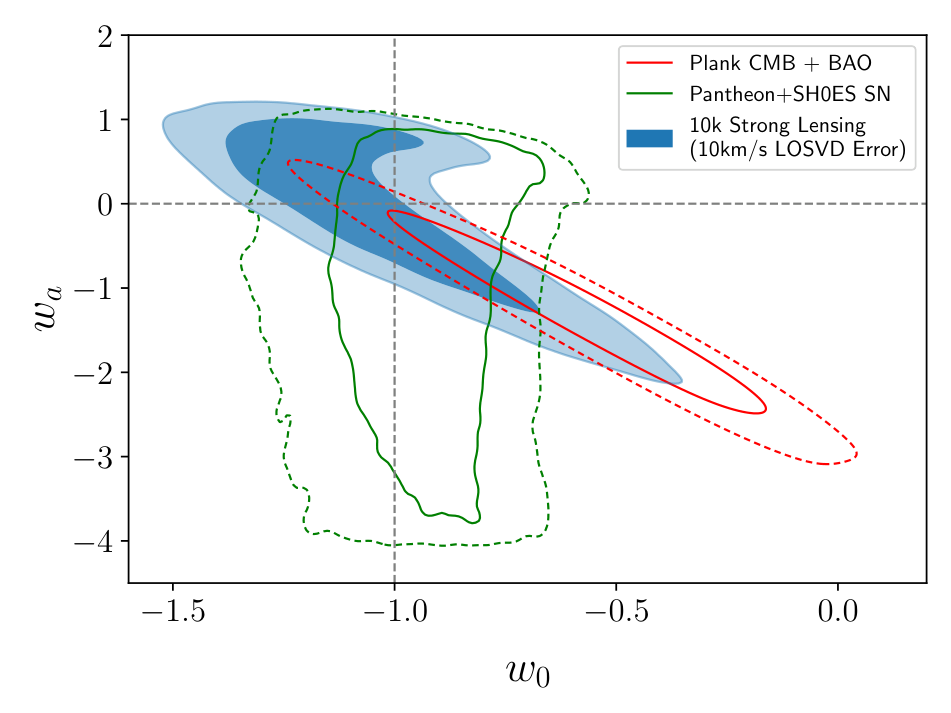
Future wide-area surveys should discover more than 104 galaxy-galaxy strong lenses, opening the door to cosmological inference from whole lens populations rather than only a few exceptional systems. This paper develops a hierarchical model that jointly fits lens-population parameters and cosmology by combining Einstein-radius measurements with stellar-dynamical mass estimates for every lens.
After marginalizing over lens density profiles and stellar orbital anisotropies, the forecast precision reaches about σ(w) ≃ 0.11 with 10,000 systems, potentially stronger than current single-probe constraints. Applying the method to 161 existing lenses gives w = −0.96 ± 0.46, and the work also shows how to reduce the impact of possible redshift evolution in the mean lens density profile of the population.
072021AGN / OPTICAL VARIABILITY
Intra-day variability of BL Lacertae from 2016 to 2018
Tian Li, Jiang-Hua Wu, Nan-Kun Meng, Yan Dai, Xiao-Yuan Zhang · Research in Astronomy and Astrophysics 21, 259
View paper ↗
ABSTRACT
BL Lacertae was monitored in the B, V, R, and I bands on 14 nights during 2016–2018, and significant intra-day variability was detected on 12 of those nights. The colour-magnitude analysis shows a clear bluer-when-brighter trend, with at least part of that chromatic behaviour driven by larger variability amplitudes at shorter wavelengths.
The variability patterns in different optical bands are tightly correlated, and the analysis finds no measurable inter-band time lag. Together, the data indicate rapid but coherent optical variability across the monitored bands.