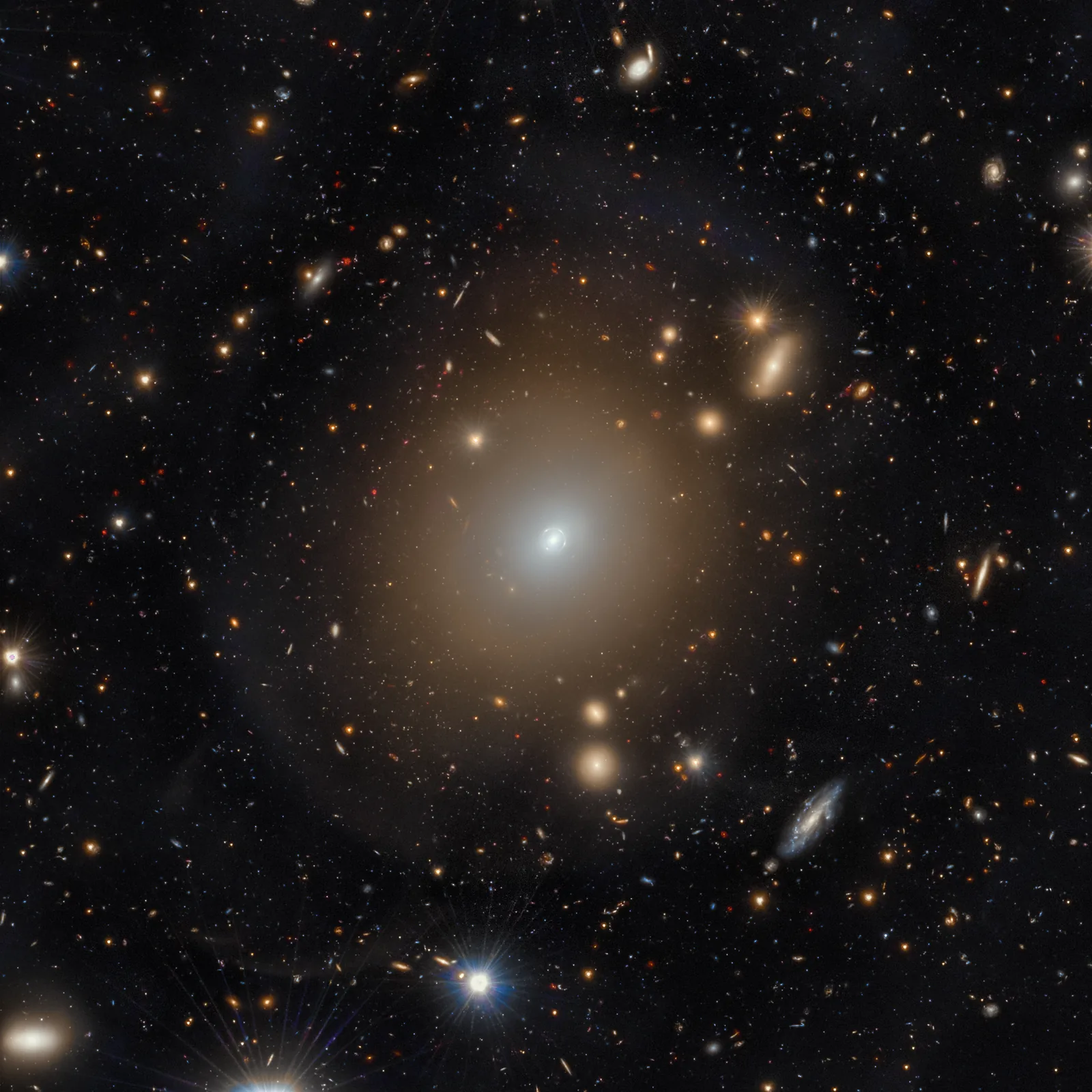

A Salpeter IMF and an NFW halo: disentangling the dark and stellar mass of an elliptical galaxy through precise lens modelling of a double-source-plane system
arXivAbstract
We use the double-source-plane lens J0946+1006 to separate stellar and dark matter components with a flexible two-component mass model. The stellar light is described with a multi-Gaussian expansion, a free global $M/L$, and an allowed radial $M/L$ gradient, while the halo is modeled as an elliptical generalized NFW profile. The extra leverage from the double-source-plane geometry helps suppress the mass-sheet transformation and tighten constraints on the radial mass profile.
Even with this freedom, the preferred solution remains close to the canonical picture of a massive elliptical galaxy: an almost constant stellar $M/L$ with Salpeter-like IMF normalization and a halo consistent with NFW. The inferred parameters are $M_{\star}=4.4^{+0.25}_{-0.39}\times10^{11}\,M_{\odot}$, $\gamma_{\rm in}^{\rm halo}=1.04^{+0.10}_{-0.14}$, and $M_{200}^{\rm halo}=1.11^{+0.37}_{-0.32}\times10^{13}\,M_{\odot}$, suggesting a practical template for future Euclid double-source-plane lens analyses.